



A responsible gambling marketing strategy after DraftKings' AI score
DraftKings scored bettors the way a bookmaker prices a favourite: by how much they were expected to lose. That is not a scandal for operators to watch from a safe distance, it is a brief for the growth team building the next personalisation model.
What DraftKings' AI actually scored
We are looking for traits and features that we can target that indicate a good investment. The best investment would be a problem gambler.
That line, told to reporters by a former employee who helped build the tool, is the reason this is a responsible gambling marketing strategy story and not only a compliance one. Growth teams across regulated betting build scoring models like this every quarter. The question DraftKings just answered in public is what happens when nobody stops to ask what the model is actually for.
A New York Times investigation published 19 September 2026, built on internal documents and interviews with more than forty former employees, found that DraftKings built a machine learning model in 2023 to rank customers by how much they were likely to lose after a promotional offer, according to Tech Times' detailed account of the reporting. Staff called the output an elasticity score.
The model weighed three signals: how often someone played, how their account balance moved day to day, and what share of their wagers they actually lost, per The Daily Caller's reporting on the same investigation. None of that is exotic. Every CRM team in iGaming already tracks frequency, balance and loss ratio, because those numbers are how you tell a casual player from a whale. What made the elasticity score different was the label DraftKings put on the output, not value but likely loss, and the promotional budget that followed the highest scorers.
The scale is what turns a modelling choice into a responsible gambling marketing strategy question rather than a data science footnote. DraftKings directed close to $400 million in AI-automated promotions at its highest-scoring accounts in 2025, and told investors that the underlying analytics lifted margins on promotion-driven sportsbook bets by 13 percent over the same year, according to Startup Fortune's summary of the disclosure. That 13 percent is not a rounding error on a spreadsheet. It is the number an activist board member or a plaintiff's lawyer asks about first.
DraftKings disputes the framing. The company told reporters its promotions are directed toward customers who demonstrate sustained, engaged use of its platform, not toward customers based on their losses, a position Gizmodo reported in full. That defence matters for this piece, because it is the exact defence every operator running a loyalty score will reach for once a journalist asks the same question of their own model. The honest test is not what you call the score. It is what the score was trained to predict.
The clearest evidence that DraftKings understood the risk sits in what it chose not to ship. A data scientist named Nestor Hernandez built a separate model in 2024 specifically to flag accounts sliding toward crisis, using much the same behavioural data as the elasticity score. According to Startup Fortune's reporting, that harm-detection model never made it past a cancelled presentation. The company had the capability to warn a player before he lost control. It kept the capability that warned the company instead.
None of this is a US-only lesson. Operators licensed through Curacao, Anjouan or Malta run the same class of behavioural scoring models, often with lighter regulatory scrutiny than DraftKings faces in Massachusetts or the states covered by the UK's rules. Lighter scrutiny today is not the same as permanent immunity from a story like this one, and a responsible gambling marketing strategy built only for the compliance bar in a lenient jurisdiction is the one most likely to be caught flat-footed when a journalist starts asking for training data instead of a licence number.
One former analyst who tested the system called it, plainly, as predatory as it sounds, according to Operation Sports. A fox does not need a label to know the scent of its own den. Neither does a growth team, when it is honest with itself about what a model is actually optimising for.
Where CRM personalisation turns into liability
Every competitive iGaming operator personalises, and every one of them needs a responsible gambling marketing strategy robust enough to survive its own data. Deposit-matched offers, free spins tuned to a player's favourite slot, a sportsbook boost timed to Sunday kickoff: none of that is controversial on its own, though the real cost of a welcome offer is rarely as visible as the headline number, something we mapped in The offer is loud. The cost is invisible. The trouble starts when the inputs to that personalisation model start to resemble the inputs a clinician would use to spot a gambling problem.
Playing frequency, day to day balance swings, loss to wager ratio: DraftKings' elasticity score used exactly the three markers that show up in most clinical screening tools for problem gambling, because compulsive play produces a distinctive shape in that data whether or not anyone labels it that way. A model trained to predict who will lose the most after a bonus will, without anyone writing a single addiction-related rule into it, learn to find the same people a screening tool would flag. That is the mechanism, not a conspiracy. It is also exactly why a growth team cannot treat we didn't target addiction, we targeted value as a complete answer.
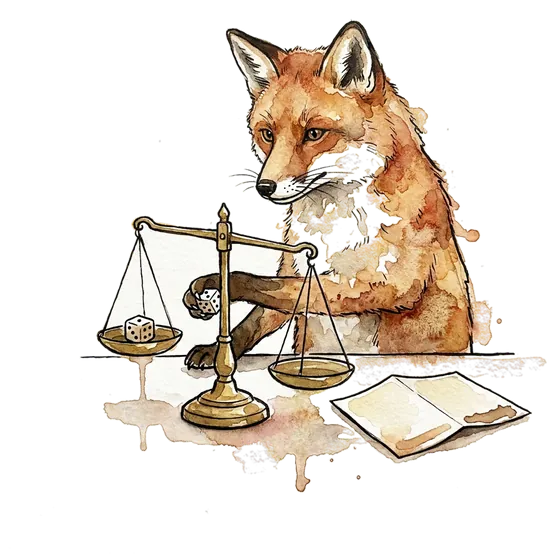
This is where a responsible gambling marketing strategy earns its keep as a genuine growth discipline rather than a compliance tax, the same discipline folkfox brings to every iGaming marketing engagement in a regulated vertical. The operators who will survive the next five years of scrutiny are not the ones who personalise least. They are the ones who can show, in plain language, what their model optimises for and why that target is defensible if a journalist ever gets the training data.
A fox that hunts only by scent, without ever checking what it has actually caught, eventually drags something home it cannot eat. The same is true of a scoring model built purely on behavioural elasticity: it will find your best quarry and your most vulnerable customer using the same maths, because at the level of raw data those two players can look identical. A fox's cunning is only useful in service of caution, never carelessness, and building a responsible gambling marketing strategy that tells the two apart, on purpose, before a journalist does it for you, is the actual work of this decade in iGaming growth.

The commercial case, and the ceiling above it
The commercial logic behind DraftKings' model is not hard to follow, and pretending otherwise does a disservice to the marketers reading this. A 13 percent margin lift on promotion-driven sports bets, in a business where promotions run into the billions, is the kind of number that gets a CMO promoted. DraftKings gave out roughly $3 billion in promotions against $8.7 billion in gross gambling revenue in 2025, and an executive credited data science with pulling a meaningful share of that spend toward the customers most likely to respond to it, according to The Daily Caller. That is the commercial argument for the kind of aggressive, AI-driven responsible gambling marketing strategy DraftKings built, and it is a real one.
| Item | Value |
|---|---|
| 13% margin lift on promotion-driven | 13% margin lift on promotion-driven |
| sportsbook bets, 2025 | sportsbook bets, 2025 |
That is the number every growth team chasing a similar strategy needs to hold next to a second one: concentration. Roughly 42 percent of DraftKings' revenue came from just 3.8 percent of its user base, per Tech Times' reporting on the underlying data. Read plainly, that means the model's most valuable customers and its highest-risk customers are drawn from the same small pool, which is precisely the overlap a plaintiff's lawyer, a regulator or a documentary producer will point at first.
| Item | Value |
|---|---|
| Share of 2025 revenue | 42 |
| Share of user base | 3.8 |
None of this means personalisation itself is the problem. It means a responsible gambling marketing strategy has to include a ceiling: a point at which the model's own success becomes the story, not the operator's. Set that ceiling before a journalist sets it for you, and the commercial case for personalisation survives. Skip it, and the 13 percent margin lift becomes the headline's opening figure instead of a footnote in an earnings call.
Growth teams that get this right treat the ceiling as a design constraint, the same way a media buyer treats frequency capping. It is engineering a model that can be explained in a single, honest sentence to a board member, a regulator and a reporter, without the sentence changing. That is brand work as much as data science, which is why folkfox treats brand strategy and player protection as one deliverable, not two. Affiliates sit inside this same exposure even though they rarely build the scoring model themselves: promoting an operator's welcome offer means promoting the targeting logic behind it, and we just ran the banner is no longer a workable defence.
The regulatory tripwires already in place
Regulators have been circling this exact behaviour for years, which is the part of the DraftKings story that should worry operators more than the headline itself. This is not a hypothetical risk a legal team can wave off as unlikely enforcement. The rules, or the proposals for them, already exist in the jurisdictions that matter most to any operator's responsible gambling marketing strategy.
It is worth answering the question plainly, because readers keep asking it in two forms: is it illegal to promote gambling? And, closely related, is it illegal to advertise gambling? Neither, in the regulated markets this article covers. Advertising and promoting sports betting and casino products is legal wherever an operator holds an active licence. The legality question almost never centres on the promotion itself. It centres on the targeting method behind it, exactly the ground DraftKings' elasticity score is now being tested on.
Jurisdiction matters here too. A Curacao or Anjouan licence carries a lighter marketing rulebook than Massachusetts or the UK, which is precisely why operators in those tiers often build the most aggressive personalisation models: the regulatory ceiling is higher, so nothing stops the model until the market does. The Massachusetts Gaming Commission's durable suitability review process shows how a single investigation can put an entire licence back on the table years after it was granted.
None of these rules currently ban an elasticity score outright in every US state DraftKings operates in, which is exactly why the reputational exposure matters as much as the legal exposure. A responsible gambling marketing strategy built only to clear today's legal bar is already out of date, because the SAFE Bet Act shows where federal appetite is heading, and the UK's 70 percent VIP contraction shows what happens once a regulator actually enforces the standard it has already written down, a pattern we traced across regulated funnels more broadly in There is no universal funnel, only a different rulebook at every step.
Optimised for one number
Rank every account by predicted post-promotion loss, and route the biggest budget to the highest scorers, with no upper bound and no harm signal in the loop.
Optimised for a defensible outcome
Rank accounts by lifetime value and run every score against a harm-indicator ceiling, so any account that trips both a high-value and a high-risk threshold is routed to a human, not a bigger bonus.
The second column is not a weaker strategy. It is a more disciplined one, and discipline is what marketing teams in regulated categories are actually paid for. DraftKings had exactly this second model in prototype, not unlike the integrity work we covered in Prediction markets are turning integrity into a growth layer: a data scientist built a harm-detection system in 2024 specifically to flag accounts sliding toward crisis. The company shelved it before it shipped, according to Startup Fortune. That single decision, choosing not to deploy a model the company already knew how to build, is the detail that will define how this story is read for years.
the business model relies on systematically cutting off successful betters while catering heavily towards unsuccessful betters... a good regulatory move might just be to restrict this kind of market segmentation which would force these businesses to actually take risk.
That is a policy read from outside the industry, but it lands on the same point a good in-house counsel would make from inside it: the regulatory fix under discussion is not a content rule, it is a targeting rule. Growth teams that keep tracking and targeting the same accounts purely for extraction, rather than genuine demand, are building the exact thing federal legislators keep proposing to ban. The ethical framing is already spreading beyond the trade press too: one commentator argued DraftKings raises its profit by targeting those who may or already have developed a gambling addiction, a characterisation Psychology Today published within days of the investigation, and exactly the coverage a defensible personalisation model is built to avoid earning.

Building a defensible personalisation stack
None of this argues for retreating from personalisation. It argues for building a responsible gambling marketing strategy a growth team can defend in a boardroom, a bulletin and a byline, using the same sentence each time. That is achievable, and most of what it requires is already sitting in a modern CRM stack, just aimed differently, which is the same starting point folkfox uses for AI consultancy work with regulated clients.
Harm-indicator overlap
Share of top-elasticity accounts that also trip a harm-risk threshold. Monitored weekly, escalated, never rewarded.
Promo budget capped
Share of top-tier promotional spend with a hard per-account ceiling, regardless of predicted responsiveness.
Model explainability
Share of scoring features a marketing lead can name and justify without engineering support.
Track those three numbers with the same seriousness a finance team gives to margin, because a responsible gambling marketing strategy that is not measured monthly is a policy document, not a working programme. Report harm-indicator overlap to the same leadership audience that reviews promotional ROI, on the same cadence, using the same dashboard. The moment player protection metrics live in a separate report that nobody in the growth meeting reads, the model has already drifted back toward whatever DraftKings built in 2023.
Five moves separate a responsible gambling marketing strategy that survives scrutiny from one that becomes a headline. None of them are novel. All of them are missing from most operators' loyalty models today, because nobody has been forced to track signal separately from spend, and write the difference down.
| Move | Owner | Evidence it worked |
|---|---|---|
| Cap the ceiling | Growth | No account exceeds a fixed promo limit regardless of predicted value |
| Separate value from vulnerability | Data science | Harm-indicator features are logged and reviewed apart from value features |
| Name the label honestly | Compliance | Model documentation states what the score predicts, not a euphemism |
| Route high-overlap accounts to a human | CRM ops | Accounts scoring high on both value and risk get manual review, not automation |
| Publish the policy | Brand | A public page states how personalisation and player protection interact |
- Cap the ceilingGrowthNo account exceeds a fixed promo limit regardless of predicted value
- Separate value from vulnerabilityData scienceHarm-indicator features are logged and reviewed apart from value features
- Name the label honestlyComplianceModel documentation states what the score predicts, not a euphemism
- Route high-overlap accounts to a humanCRM opsAccounts scoring high on both value and risk get manual review, not automation
- Publish the policyBrandA public page states how personalisation and player protection interact
The companies that get hired to build this well are not always the biggest names in performance marketing. The best responsible gambling marketing companies in this category tend to be smaller, regulated-vertical specialists who have already sat across the table from a gaming commission, because that experience shows up in the model design from the first sprint, which is the whole point of hiring for a responsible gambling marketing strategy rather than a generic growth retainer. If you want a sense of scope before that conversation, folkfox's pricing page lays out how that work is packaged.
It also raises a fair question for anyone new to the category, namely what is a gambling marketer? Strip away the stereotype of odds boosts and free-bet spam, and the job is closer to a risk manager who happens to write good copy: someone building acquisition and retention programmes inside a licence, a harm-prevention framework and a public trust budget, all at once. The DraftKings story is a reminder that skipping any one of those three breaks the other two.
A fox earns its den by knowing exactly which ground is safe to dig and which is not. A responsible gambling marketing strategy does the same job for a growth team: it does not stop the hunt, it tells you where not to dig. Build that discipline into the model before the next investigation finds it for you, and the 13 percent margin lift becomes a case study instead of a subpoena exhibit.
Frequently asked questions
What does responsible gaming draftkings actually mean in practice?
It means DraftKings publishes self-exclusion tools, deposit limits and reality checks inside its product, even as its own promotional AI was reportedly optimised around predicted losses rather than player welfare. The gap between the public-facing responsible gaming programme and the internal targeting model is exactly what the New York Times investigation exposed, and exactly what a genuine responsible gambling marketing strategy has to close.
Is it illegal to promote gambling?
Not generally, in the regulated markets folkfox works in. Sports betting and casino advertising are legal where an operator holds an active licence, such as a Massachusetts Category 3 sports wagering licence or an MGA authorisation. What can cross into illegal or licence-threatening territory is the targeting method behind the promotion, not the promotion itself, particularly where a regulator like the UK Gambling Commission has already written explicit rules against it.
What is a gambling marketer?
In a regulated vertical, a gambling marketer is part growth specialist and part risk manager. The role covers acquisition, retention and loyalty programmes, but every campaign has to clear a licence condition, a responsible gambling standard and a brand-trust test before it ships. That is a wider brief than most performance marketing roles, and it is why responsible gambling marketing companies increasingly hire compliance-literate strategists rather than pure media buyers.
Did DraftKings break the law with its elasticity score?
No US regulator has publicly ruled that the elasticity score itself was illegal, and DraftKings disputes that its promotions targeted losses rather than engagement. What the story changes is the political and regulatory climate: the federal SAFE Bet Act would ban exactly this kind of AI-driven personalised targeting outright, and operators building similar models should assume that climate, not today's enforcement gap, is the one they will be judged against.
How is a responsible gambling marketing strategy different from a standard CRM personalisation programme?
A standard CRM programme optimises purely for value: who is most likely to deposit again. A responsible gambling marketing strategy adds a second axis, a harm-indicator check, and routes any account that scores high on both value and risk to a human reviewer instead of a bigger bonus. The model, the data and the marketing team can stay almost identical. What changes is the ceiling.
There is no universal funnel, only a different rulebook at every step
How the regulated funnel changes acquisition mechanics state by state.
Read the funnel briefCasino marketingThe offer is loud. The cost is invisible
What a welcome offer actually costs once you follow the money past day one.
See the real costiGaming growthPrediction markets are turning integrity into a growth layer
Why DraftKings and its rivals are turning market integrity into a marketing asset.
Read the integrity briefSportsbook advertisingThey Paid for the Exclusive. It Walked Out Anyway
What happens to an exclusivity deal once a prediction market undercuts it.
Read the exclusivity storyNeed a responsible gambling marketing strategy that holds up under scrutiny?
A responsible gambling marketing strategy is only as strong as the growth partner behind it, and folkfox builds exactly that for regulated iGaming operators: programmes that survive a compliance review and an investigative journalist asking the same question twice.
Want folkfox in your Google results and AI answers? Set folkfox as a preferred source.